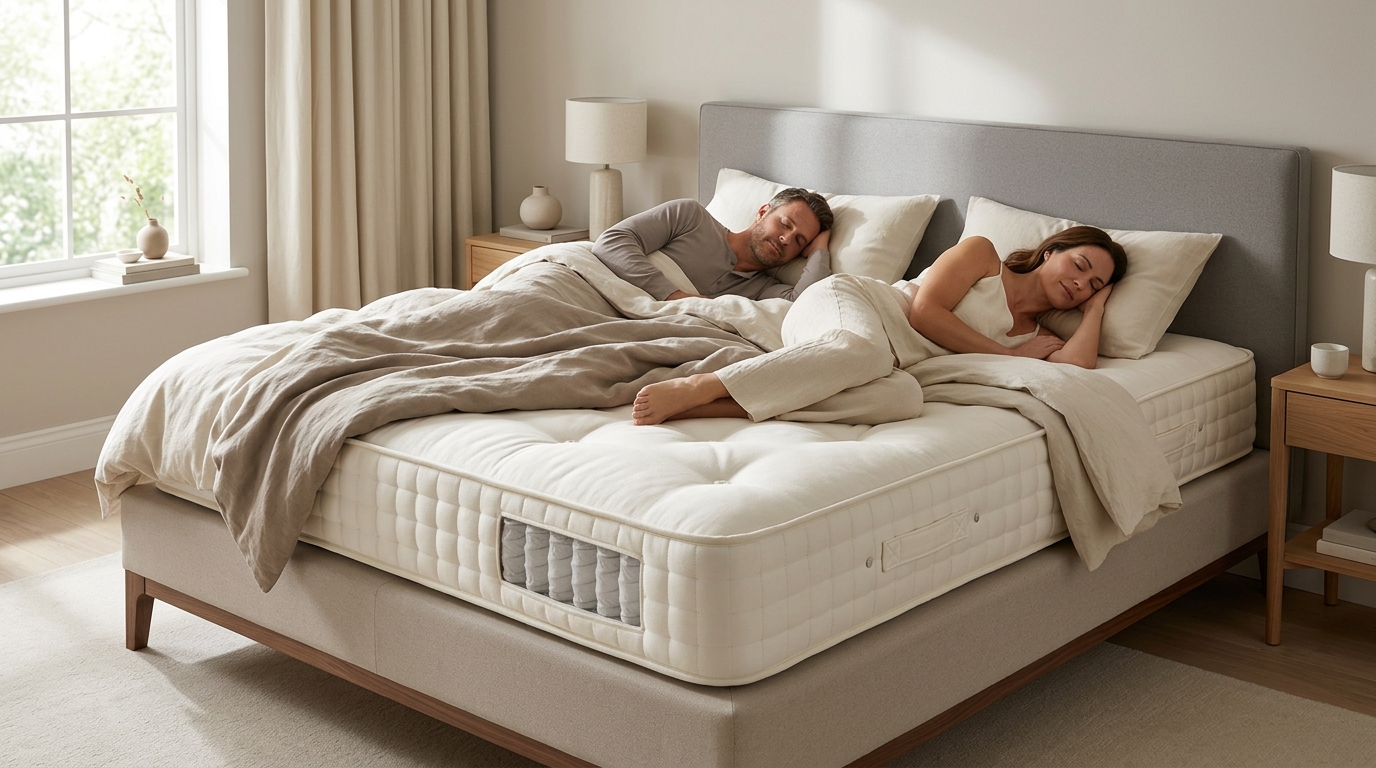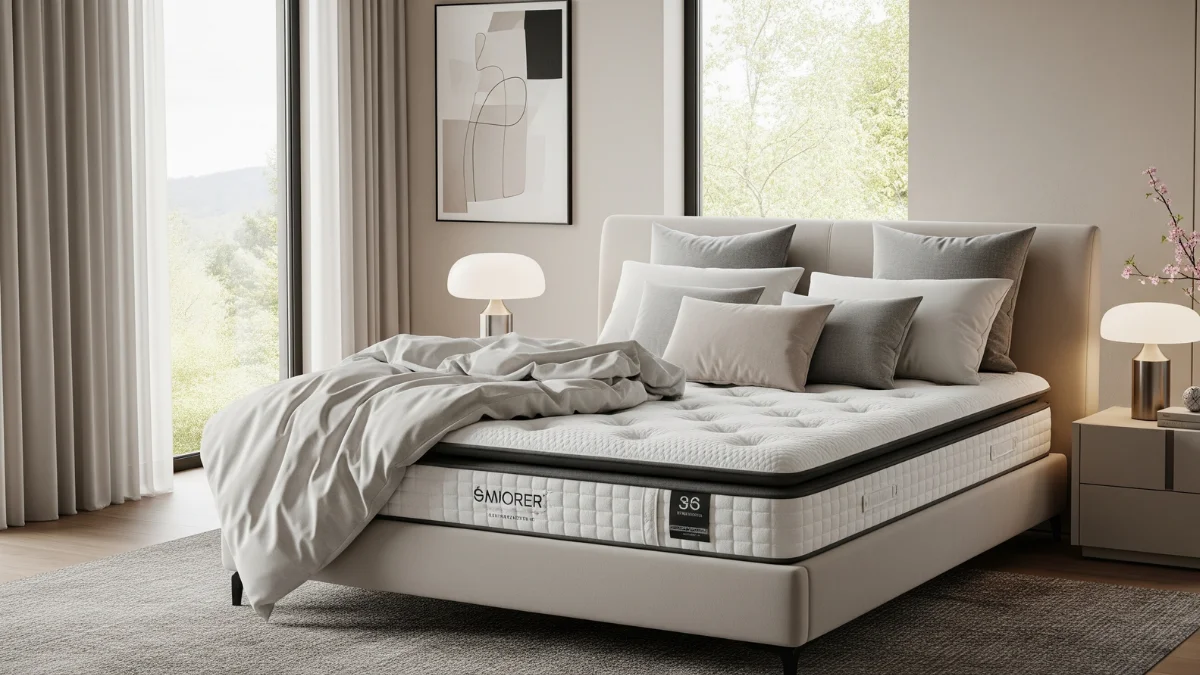
You already know the feeling. You wake up at 3am, flip your pillow to the "cold side," and spend ten minutes trying to find a position that doesn't hurt your shoulder or your lower back. If that sounds familiar, you're not tired because of stress alone — you're tired because you're sleeping on the wrong setup. Finding the best bed for sleeping isn't about buying the most expensive mattress in the showroom. It's about matching your body, your sleeping position and your bedroom to a mattress and base that actually work together.
This guide walks through everything that actually matters: firmness, support, materials, bed bases, body weight, partner needs, temperature and budget — so you can shortlist the right option instead of guessing.
Key Takeaways
- There is no single best bed for sleeping — the right choice depends on your sleeping position, weight, temperature preference and whether you share the bed.
- The mattress and the bed base work as one system. A great mattress on the wrong base underperforms.
- Side sleepers generally need more pressure relief; back and stomach sleepers generally need firmer support.
- Firmness is a feel, not a quality rating — a "medium" mattress can feel completely different depending on construction and your body weight.
- Warranty length and marketing labels like "orthopaedic" or "luxury" don't guarantee comfort or durability — construction does.
Table of Contents
- What Is the Best Bed for Sleeping in 2026?
- In My Experience, the Mattress Is Only Half of the Sleep System
- What Makes a Bed Actually Good for Sleeping?
- People Choose the Wrong Mattress Type
- Choosing a Bed Without Considering Sleeping Position
- What Most People Get Wrong Is Ignoring Body Weight
- Couples Need a Different Decision Framework
- Best Bed for Hot Sleepers: What Actually Helps?
- Best Bed for People Who Wake Up Uncomfortable
- Don't Just Look at Mattress Thickness
- The Bed Size Guide
- Pocket Springs vs Memory Foam vs Hybrid
- Divan vs Platform vs Slatted Bed
- A 7-Step Method for Choosing the Best Bed
- How to Test a Mattress Properly Before Buying
- Warranty, Trial Period and Returns
- Common Mistakes to Avoid When Buying a Bed
- Best Bed for Different Real-Life Situations
- AI Tools and Mobile Apps Can Help You Shortlist a Bed
- How to Compare Beds Without Getting Tricked by Marketing
- A Simple Decision Matrix
- Pros and Cons of the Main Bed and Mattress Choices
- What Does the "Best Bed" Actually Mean for You?
- Frequently Asked Questions

What Is the Best Bed for Sleeping in 2026?
The best bed for sleeping is one that gives your spine proper support, relieves pressure at the shoulders and hips, keeps you at a comfortable temperature and offers enough space to move without disturbing a partner. There isn't one mattress that ticks every box for every body — the "best" one is the one built around how you actually sleep.
It helps to separate "best bed" from "best mattress." The bed is the whole system — mattress, base or frame, size and even the bedroom environment. The mattress is just one part of that system, though it's the part most people focus on entirely.
No single mattress type suits everyone because sleeping position, body weight, room temperature and personal comfort preference all pull in different directions. A mattress that feels perfect to a lightweight side sleeper can feel unsupportive to a heavier back sleeper. Throughout this guide, we'll use those factors — position, weight, firmness, temperature, partner needs and budget — as the decision framework.
The Short Answer for Most Sleepers
If you want a quick rule of thumb before reading further, here's the shortest version:
- Side sleeper: pressure relief plus responsive support
- Back sleeper: balanced support with lumbar comfort
- Stomach sleeper: stronger support and reduced hip sinking
- Combination sleeper: a responsive surface with balanced firmness
- Couple: good motion control and solid edge support
- Hot sleeper: breathable construction with real airflow
None of these is "better" than the others — they're just suited to different needs.
What Most People Get Wrong About the "Best" Bed
Expensive doesn't automatically mean better. A £2,000 mattress with the wrong firmness for your body will still leave you tossing and turning. What matters is whether the construction matches your sleeping position and weight, not the price tag on the label.
Thickness is another red herring. A 30cm mattress isn't automatically more supportive than a 22cm one — what's inside those layers matters far more than the overall height.
Showroom softness is also misleading. Lying on a mattress for 60 seconds in daytime clothes tells you almost nothing about how it will feel after eight hours. And marketing language — "plush," "cloud-like," "orthopaedic" — describes a feeling, not a fact about your spine.
In My Experience, the Mattress Is Only Half of the Sleep System
In our showroom experience, customers spend 90% of their time comparing mattresses and about 30 seconds thinking about the base underneath. That's backwards. A mattress performs differently depending on what it's sitting on.
A soft, unsupportive base can make even a well-built mattress sag prematurely or feel less supportive than it's designed to be. A base that's too rigid, on the other hand, can make a plush mattress feel unexpectedly firm. Divan, platform and slatted bases all interact with the mattress differently, which is why manufacturers publish compatibility guidance — and why it's worth actually reading it before you buy.
Bed height and bedroom space matter too. A tall divan with storage might suit someone with mobility needs, while a low platform bed might suit a small room with a minimalist look.
Mattress vs Bed Frame: Which One Matters More?
They do different jobs, so it's not really a competition. The mattress handles comfort, pressure relief and body support. The frame or base provides stability, ventilation, height and the structural support that keeps the mattress performing as intended. Evaluate them together, not one after the other — because a fantastic mattress can be let down by a base that doesn't ventilate or flex correctly.
Most People Ignore This Part: Your Bed Base
A few common options, and when they make sense:
- Divan beds — solid, often with storage, good for a traditional feel and firm underlying support.
- Slatted frames — allow airflow underneath the mattress, useful for hot sleepers and foam or latex mattresses that need ventilation.
- Platform beds — low profile, minimal, good for smaller or more modern bedrooms.
- Storage beds — practical for small bedrooms or anyone short on wardrobe space.
- Adjustable bases — allow you to raise the head or feet, useful for reading, reflux or specific comfort preferences.
What Makes a Bed Actually Good for Sleeping?
Rather than vague "luxury" claims, it helps to judge a bed against a practical checklist: support, pressure relief, firmness suitability, temperature regulation, motion isolation, edge support, ease of movement and durability. Let's go through each one.
Support and Spinal Alignment
Neutral alignment simply means your spine stays roughly in its natural curve, whether you're on your side, back or front. Too much sinking pulls your hips out of line; too little cushioning leaves pressure building at your shoulders and hips. The "right" amount of support genuinely shifts depending on your sleeping position, which is why this isn't a one-size-fits-all spec.
Pressure Relief for Shoulders, Hips and Other High-Pressure Areas
Side sleepers usually need the most contouring because their body weight concentrates on two narrow points — the shoulder and the hip. Foam and latex comfort layers, or a pocket-spring-and-foam hybrid, tend to contour more closely than a basic innerspring. It helps to think of cushioning (how it feels on top) as separate from support (what holds your spine in place underneath) — a mattress needs both, not just one.
Firmness: Soft, Medium, Medium-Firm or Firm?
Firmness describes a feeling, not a quality scale — firmer isn't inherently "better" support. A heavier person will sink further into any given mattress than a lighter person, which is why the same medium-firm model can feel completely different from one body to another. Construction matters just as much as the firmness label on the box.
Temperature Regulation and Breathability
Heat retention happens when a mattress traps body heat instead of letting it escape. Pocket springs generally allow the most airflow because of the open space between coils; latex is naturally breathable due to its cellular structure; memory foam, depending on density, can retain more heat unless it's been engineered with cooling gel or an open-cell structure. Breathable covers help, but they can't fully offset a dense foam core. If you regularly wake up too warm, this is one of the biggest factors to prioritise — more on that shortly.
Motion Isolation for Couples
If a partner's movement wakes you up, motion isolation is worth prioritising. Memory foam absorbs movement well; pocket springs, because each coil moves independently, isolate motion better than old-style interconnected springs. Responsiveness and motion absorption sit at opposite ends of a spectrum — the more absorbent a surface is, the less "bouncy" it tends to feel.
Edge Support
Edge support determines how much of the mattress you can actually use. Weak edges shrink your usable sleeping surface, which matters more for couples, larger sleepers, or anyone who sits on the edge to get dressed. Reinforced perimeter coils or firmer foam borders are the usual solution.
Ease of Movement
A highly contouring mattress can feel wonderful for pressure relief but restrictive if you change position often, because it takes a moment to "un-sink." Springs and latex respond faster than dense memory foam; hybrids usually sit somewhere in between.
Durability and Long-Term Value
Sagging and loss of resilience are the two biggest signs a mattress construction has broken down. A longer warranty is one signal of quality, but it isn't proof on its own — always check what the warranty actually covers before assuming it guarantees durability. Judge price against expected lifespan and suitability, not against the number on the price tag alone.
I've Seen This Happen Many Times: People Choose the Wrong Mattress Type
A common mistake we see is picking a mattress because a friend loves it, without checking whether the construction actually suits a different body and sleeping position. Here's a rundown of the main types.
Pocket Sprung Mattress
Individually wrapped springs move independently, giving good support, strong airflow and decent responsiveness. Motion transfer and edge support vary a lot depending on spring count and design. Often preferred by people who want a traditional, bouncier feel with good breathability.
Memory Foam Mattress
Known for contouring, pressure relief and strong motion isolation. Heat retention can be a downside depending on foam density, and the slower "sink-in" response doesn't suit everyone. Works well for side sleepers wanting pressure relief; less ideal for hot sleepers or people who move a lot at night.
Latex Mattress
Latex has a responsive, slightly bouncy feel, good durability and solid airflow thanks to its naturally aerated structure. Natural latex tends to be more breathable and durable than synthetic latex, though synthetic versions are usually more affordable.
Hybrid Mattress
Combines a spring support core with foam or latex comfort layers, aiming for both responsiveness and cushioning. Construction varies significantly between brands — the ratio of springs to foam changes how firm, cool or contouring the mattress feels.
Traditional Innerspring Mattress
Interconnected coils (rather than individually wrapped) move as one unit. Generally responsive and breathable, but with less motion isolation and contouring than pocket springs or foam.
Orthopaedic and "Support" Mattresses
"Orthopaedic" is a marketing term, not a regulated medical classification — it doesn't automatically mean the mattress will help back pain. Look past the label and assess the actual construction, firmness and support core before assuming any medical benefit.
Also read: Best Mattress for Back Pain in 2026: What Actually Helped Me Sleep Without Waking Up Sore
Honestly, I Made This Mistake Too: Choosing a Bed Without Considering Sleeping Position
I bought a firm mattress once because it "felt supportive" in the showroom — then spent six months as a side sleeper with a sore shoulder every morning. Sleeping position should be the very first filter, not an afterthought.
Best Bed for Side Sleepers
Priorities: shoulder pressure relief, hip cushioning, a supportive core underneath, and firmness that isn't so hard it creates pressure points. Pocket sprung with a foam comfort layer, pure memory foam, or a foam-forward hybrid all work, depending on preference.
Best Bed for Back Sleepers
Priorities: balanced support, some lumbar-area support, moderate contouring and a stable surface that doesn't let the hips sink too far below the shoulders.
Best Bed for Stomach Sleepers
Priorities: preventing excessive hip sinking and keeping the surface stable and reasonably firm. A very soft mattress can let the midsection drop, pulling the lower back out of alignment — this is the one position where "soft and plush" often backfires.
Best Bed for Combination Sleepers
Combination sleepers need responsiveness above all — a surface that lets them change position easily without feeling stuck. Balanced, medium-firm hybrids tend to suit this group best.
What Most People Get Wrong Is Ignoring Body Weight
Body weight changes how much you sink into a mattress and how firm it actually feels once you're lying on it. There's no rigid weight-to-firmness formula, because construction changes the outcome too — but weight is worth factoring in deliberately.
Lighter Sleepers
Very firm mattresses can feel unexpectedly hard because there isn't enough body weight to compress the top layers. Softer comfort layers usually deliver better pressure relief for lighter frames.
Average-Weight Sleepers
This group has the widest range of workable constructions. Sleeping position becomes the more useful filter than weight alone.
Heavier Sleepers
A strong support core, solid edge support, good sag resistance and adequate thickness all matter more here. There's no single firmness that works for every heavier sleeper — construction quality is the bigger differentiator.
This Is Where Things Get Real: Couples Need a Different Decision Framework
Buying for two people means balancing competing preferences: motion isolation, mattress size, edge support and — often the trickiest part — two different firmness preferences under one roof.
What If Two People Prefer Different Firmness Levels?
Compromise options include a medium-firm mattress that splits the difference reasonably well, a split-firmness configuration where each side of the mattress is built differently, or an adjustable base that lets each side change position independently.
Best Bed Size for Couples
A double gives each person roughly the width of a single bed, which can feel tight for two adults. A king gives noticeably more personal space, and a super king is the most generous option if the bedroom can fit it. Measure the room first — a super king in a small bedroom can make the space feel cramped and hard to move around.
Also read: Best Sleep Solution for Couples: How to Finally Sleep Better Together Without Compromising Comfort
Best Bed for Hot Sleepers: What Actually Helps?
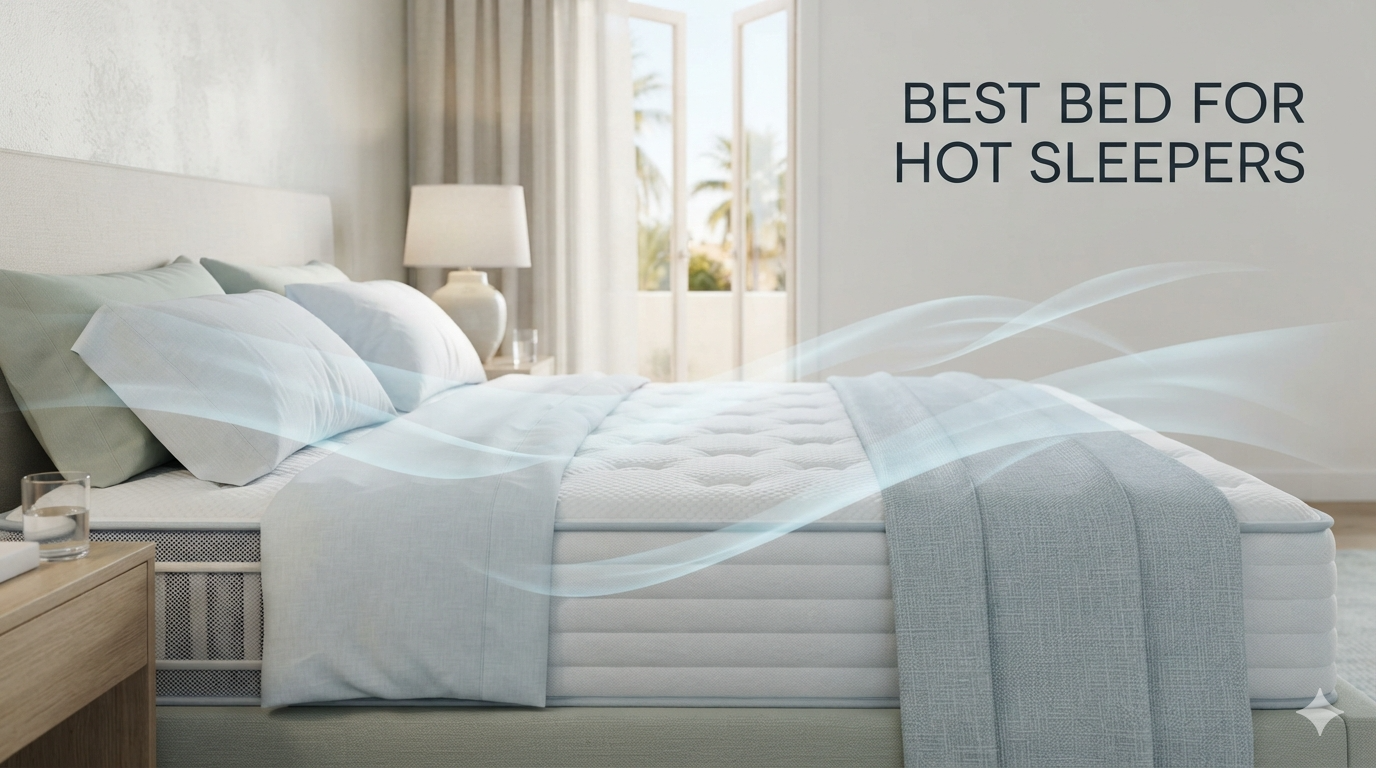
If you regularly kick off the covers at 2am, the best bed for sleeping comfortably in a warm room usually comes down to airflow. Pocket springs breathe best thanks to open space around each coil. Latex is naturally ventilated. Foam varies widely — some are engineered with cooling gel or open-cell structures, others trap heat. Hybrids sit in between, depending on the ratio of springs to foam.
Breathable covers and a well-ventilated bed base (like slats rather than a solid divan top) both help. Be cautious with "cooling" marketing — ask what specifically makes it cooling (gel infusion, open-cell foam, breathable fabric) rather than taking the label at face value.
Best Bed for People Who Wake Up Uncomfortable
Waking up sore or restless usually traces back to one of these: a mattress that's too firm or too soft, poor pressure distribution, insufficient support, excess heat, partner movement, or a worn-out mattress that's simply reached the end of its life. This is a troubleshooting list, not a diagnosis — if discomfort persists, it's worth speaking to a healthcare professional.
How to Tell If Your Mattress Is Too Soft
- You sink noticeably and feel like you're "in" the mattress rather than on it
- Changing position takes real effort
- Support feels uneven across the surface
- You can see permanent body impressions
How to Tell If Your Mattress Is Too Firm
- Pressure builds noticeably at the shoulders or hips
- You feel like you're resting "on top" rather than cushioned
- You reposition frequently trying to get comfortable
Don't Just Look at Mattress Thickness
Thickness on its own tells you very little. What matters is what's inside: the comfort layer (the top cushioning you feel first), the transition layer (which bridges softness and support), the support core (the structural base, usually springs or dense foam), and the cover (breathability and feel). Two mattresses can be the same height and feel completely different because their internal construction is different.
The Bed Size Guide: Choosing Enough Space Without Wasting Bedroom Space
Common sizes, roughly in order of space: single, small double, double, king and super king. Larger isn't automatically better — a super king that leaves no room to open a wardrobe door isn't practical. Factor in sleeper height too; taller sleepers may want to check mattress length, not just width. Note that UK and European sizing conventions differ slightly, so double-check dimensions if buying across markets.
Pocket Springs vs Memory Foam vs Hybrid: Which Is Best for Sleeping?
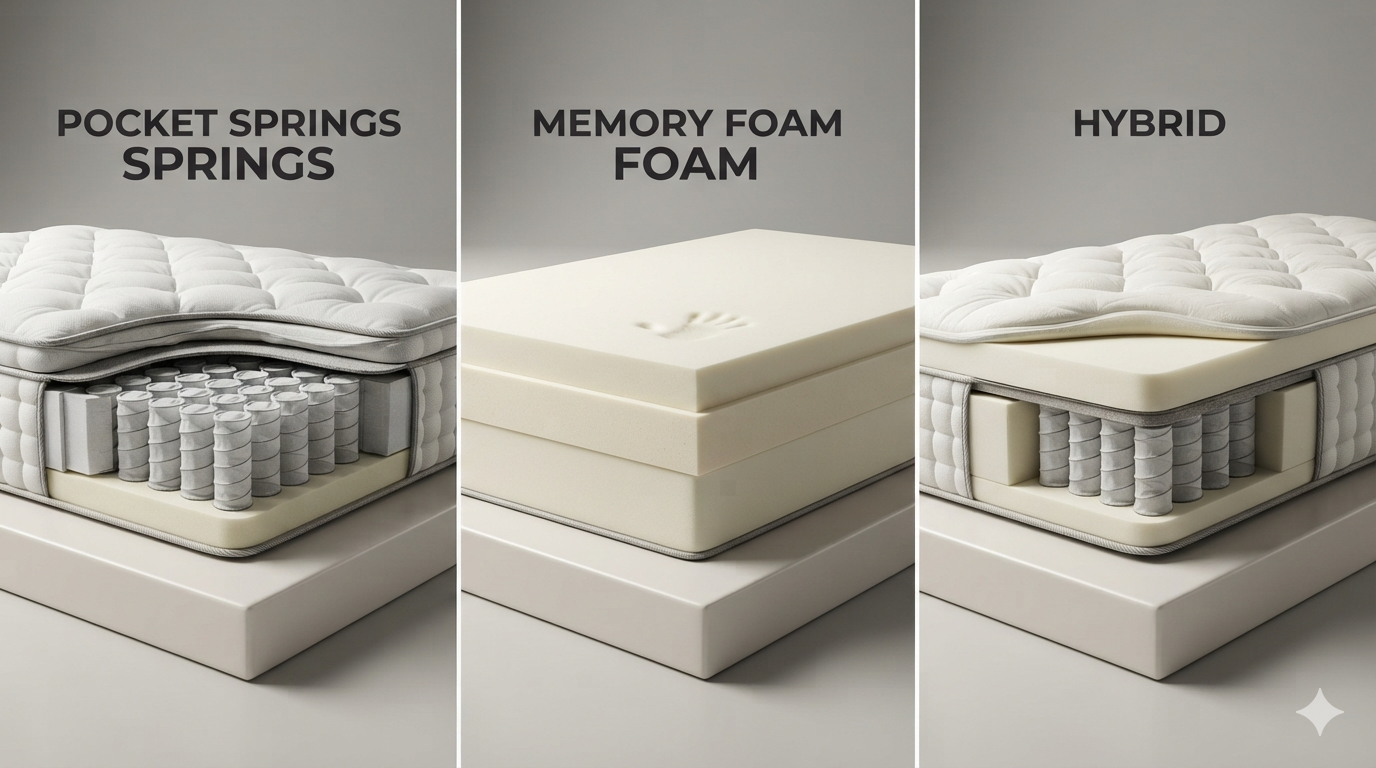
| Mattress Type | Support | Pressure Relief | Cooling | Motion Isolation | Responsiveness | Edge Support | Typical Sleeper | Drawbacks |
| Pocket Springs | Good | Moderate | Strong | Moderate | High | Varies | Back/combination sleepers | Quality varies by coil count |
| Memory Foam | Good | Excellent | Moderate to weak | Excellent | Low | Weak to moderate | Side sleepers | Can retain heat, slow response |
| Hybrid | Excellent | Good | Good | Good | Moderate | Good | Most sleeper types | Pricier, construction varies |
| Latex | Good | Good | Strong | Moderate | High | Moderate | Combination sleepers | Different feel, can cost more |
Pocket Springs vs Memory Foam
Pocket springs breathe better and respond faster; memory foam contours more closely and isolates motion better. Choose springs if you run hot or move often at night; choose foam if pressure relief and quiet nights matter more than temperature.
Hybrid vs Pocket Springs
A hybrid adds a comfort layer on top of a spring core, so it typically offers more cushioning than pure pocket springs while keeping much of the airflow and responsiveness.
Memory Foam vs Latex
Latex has more bounce and airflow than memory foam, while memory foam contours more closely and isolates motion more effectively. Neither is "better for sleeping" universally — it depends on whether you prioritise responsiveness or contouring.
Divan vs Platform vs Slatted Bed: Which Base Is Right for You?
Divans suit a traditional look and often include storage. Platform beds suit modern, low-profile bedrooms. Slatted frames suit anyone prioritising airflow, especially with foam or latex mattresses. Storage beds solve a practical space problem. Adjustable beds solve a comfort and positioning problem.
Best Bed Base for Storage
Drawer divans give easy access without lifting the mattress; lift-up ottoman-style bases give more storage volume but require moving the mattress to access it.
Best Bed Base for Small Bedrooms
Prioritise a compact footprint, built-in storage where possible, and enough clearance to move around the room comfortably.
Adjustable Beds: Who Should Consider One?
Useful for anyone who reads in bed, wants to elevate their head or legs for comfort, or simply prefers flexible positioning. Not a substitute for medical equipment — check with a healthcare provider for specific medical needs.
A 7-Step Method for Choosing the Best Bed for Sleeping
- Step 1 — Identify your main sleeping position: side, back, stomach or combination
- Step 2 — Consider your body weight and build, since it changes how firm any mattress feels
- Step 3 — Decide your firmness preference based on suitability, not marketing labels
- Step 4 — Choose the mattress construction: springs, foam, latex or hybrid
- Step 5 — Decide which features matter most: cooling, pressure relief, motion isolation, edge support or responsiveness
- Step 6 — Match the mattress to a compatible bed base
- Step 7 — Check warranty, trial period, delivery and return terms before paying
How to Test a Mattress Properly Before Buying
Don't Just Sit on the Edge for 30 Seconds
Lie in your normal sleeping position for several minutes, not just seconds. If you're buying with a partner, both people should test both sides of the bed.
Test Pressure Points
Side sleepers should pay attention to shoulder and hip comfort specifically. Back sleepers should check whether the lower back feels supported rather than gapped or over-pressed.
Test Movement
Change position a few times, sit up and lie back down, and if you're shopping with a partner, have them move around while you're lying still to gauge motion transfer.
Ask What Is Inside the Mattress
Ask about the spring system, foam layers, materials used, cover fabric, base compatibility and warranty terms before committing. A good retailer should be able to answer all of these without hesitation.
Most People Ignore This Part: Warranty, Trial Period and Returns
A long warranty sounds reassuring, but the actual conditions matter more than the number of years printed on the box. Check the sagging threshold that qualifies for a claim, what counts as a structural defect, trial period requirements, return costs, collection arrangements and delivery terms before you buy — not after a problem shows up.
Common Mistakes to Avoid When Buying a Bed
Choosing the Most Expensive Mattress
Price doesn't equal suitability. Value comes from matching construction to your needs, not from spending the most money in the shop.
Choosing Based Only on Firmness
Firmness alone doesn't guarantee good support — construction quality does the actual work.
Buying Because a Mattress Is "Orthopaedic"
Examine the construction itself rather than trusting the label.
Ignoring the Bed Base
Compatibility and structural support from the base affect how the mattress performs long-term.
Buying the Wrong Size
Measure the bedroom and the available sleeping space before choosing a size that looks good on paper but doesn't fit the room.
Ignoring Your Partner's Needs
Motion isolation and firmness compromise both matter if you're sharing the bed.
Focusing Only on Mattress Thickness
Internal construction determines comfort and support far more than headline height.
Ignoring Heat and Breathability
Especially relevant in warmer bedrooms or for naturally hot sleepers — airflow should be part of the decision, not an afterthought.
Best Bed for Different Real-Life Situations
Best Bed for Everyday Adult Sleeping
Balanced comfort, dependable support and solid durability, without over-specialising for one niche need.
Best Bed for Couples
Motion isolation, strong edge support and enough size for two people to move without disturbing each other.
Best Bed for Guest Bedrooms
Versatility and value matter more here than a highly specialised construction — guests have varied needs.
Best Bed for Small Bedrooms
Space-efficient frames, storage options and appropriately scaled dimensions.
Best Bed for Hot Bedrooms
Airflow-friendly construction and breathable covers.
Best Bed for People Who Change Sleeping Positions
Responsiveness and balanced firmness that doesn't feel restrictive when you move.
Best Bed for People Who Want Storage
Divan or dedicated storage-bed configurations.
Best Bed for People Who Want Adjustable Positions
An adjustable base paired with a compatible flexible mattress.
AI Tools and Mobile Apps Can Help You Shortlist a Bed — But Don't Let Them Make the Final Decision
In 2026, AI recommendation tools are genuinely useful for organising your requirements — sleeping position, budget, size, cooling needs and partner requirements can all be sorted into a shortlist quickly. But there are real limits worth knowing about.
AI cannot physically feel firmness the way you can. Reviews often come from people with different body types than yours, product data online can be incomplete, and recommendations can go stale as product lines change. Treat digital research as a starting point, then combine it with actual showroom testing and direct manufacturer information.
Useful Digital Tools for Mattress Research
- Manufacturer comparison tools
- Mattress-size calculators
- Bedroom measurement apps
- Sleep-tracking apps
- AI shopping and research assistants
- Review aggregation platforms
Can a Sleep App Tell You Which Mattress to Buy?
Sleep-tracking data can highlight patterns — restlessness, wake-ups, movement — but it can't independently determine which mattress construction will fix them. Use it as supporting evidence alongside physical testing, not as the final word.
How to Compare Beds Without Getting Tricked by Marketing
Terms like "luxury," "premium," "orthopaedic," "hotel quality," "cooling," "zero-gravity" and "advanced support" sound impressive but rarely explain anything concrete. Ask what the claim actually means in terms of materials and construction before it influences your decision.
Questions to Ask Before Buying
- What type of springs are used?
- What materials make up the comfort layers?
- What is the actual firmness rating?
- Is it compatible with my current base?
- What does the warranty cover?
- Is there a sleep trial?
- What happens if I need to return it?
- What delivery options are available?
- Is it suitable for my specific sleeping position?
A Simple "Best Bed for Sleeping" Decision Matrix
| Sleeper Type | Priorities | Mattress Types to Consider | Features to Check |
| Side sleeper | Pressure relief | Memory foam, foam hybrid | Shoulder and hip contouring |
| Back sleeper | Balanced support | Hybrid, pocket springs | Lumbar support |
| Stomach sleeper | Firm, stable surface | Firmer hybrid, springs | Hip sinking control |
| Combination sleeper | Responsiveness | Hybrid, latex | Ease of movement |
| Couple | Motion control, edge support | Pocket springs, hybrid | Reinforced perimeter |
| Hot sleeper | Airflow | Pocket springs, latex | Breathable cover |
| Lightweight sleeper | Softer contouring | Foam, softer hybrid | Pressure relief |
| Heavier sleeper | Sag resistance | Firm hybrid, reinforced springs | Support core strength |
| Small bedroom | Space efficiency | Platform base, compact size | Room measurements |
| Storage-focused buyer | Practical storage | Divan or storage bed | Drawer vs lift-up access |
Pros and Cons of the Main Bed and Mattress Choices
Pocket Sprung
Pros: responsive support, good airflow, wide range of firmness options. Cons: quality varies significantly by construction; motion transfer depends on design.
Memory Foam
Pros: pressure relief, motion isolation, close contouring. Cons: potential heat retention; some sleepers dislike the slower response.
Hybrid
Pros: combines spring responsiveness with comfort-layer cushioning; broad range of performance characteristics. Cons: construction varies considerably; often pricier than basic builds.
Latex
Pros: responsive, durable, airflow-friendly. Cons: different feel from memory foam; can be relatively expensive.
What Does the "Best Bed" Actually Mean for You?
By now it should be clear that the best mattress for better sleep isn't a single product — it's a combination of sleeping position, body weight, firmness, construction, temperature, partner needs, base compatibility, size and budget, all pulling in the same direction.
A quick way to shortlist:
- If your priority is pressure relief — lean toward memory foam or a foam-forward hybrid
- If your priority is cooling — lean toward pocket springs or latex with a breathable cover
- If your priority is partner disturbance — lean toward pocket springs or memory foam with strong motion isolation
- If your priority is responsiveness — lean toward latex or a spring-heavy hybrid
- If your priority is storage — lean toward a divan or dedicated storage bed
Your practical next step: measure your bedroom, identify your main sleeping position honestly, and shortlist two or three constructions that match your priorities before you go anywhere near a showroom. That single bit of prep will save you far more time than reading another ten reviews.
Frequently Asked Questions About the Best Bed for Sleeping
What is the best type of bed for sleeping?
There isn't one universal answer — the best type depends on your sleeping position, firmness preference, support needs and whether you share the bed with a partner.
What mattress is best for a good night's sleep?
Look for a mattress that offers proper support for your sleeping position, adequate pressure relief, comfortable temperature regulation and a fit that matches your body weight.
Is a firm or soft bed better for sleeping?
Neither is universally better — firmness suitability depends on sleeping position, body weight and personal comfort preference.
Is medium-firm the best mattress firmness?
Medium-firm is popular because it suits a wide range of sleepers, but it isn't automatically right for everyone — lighter sleepers and dedicated side sleepers often prefer something softer.
What is the best mattress for side sleepers?
One that prioritises shoulder and hip pressure relief while still offering adequate underlying support, such as memory foam or a foam-forward hybrid.
What is the best mattress for back sleepers?
A balanced, moderately firm option that supports the lower back without letting the hips sink too far.
What is the best mattress for stomach sleepers?
A firmer, more stable surface that prevents the hips from sinking and pulling the spine out of alignment.
Is memory foam or a sprung mattress better?
Memory foam offers stronger contouring and motion isolation; sprung mattresses offer better airflow and responsiveness. The better option depends on your priorities.
Are pocket sprung mattresses good for sleeping?
Yes, particularly for sleepers who want breathability and responsiveness, though quality varies by spring count and construction.
Are hybrid mattresses good for sleep?
Hybrids suit sleepers who want both spring responsiveness and foam or latex cushioning in one construction.
What mattress is best for couples?
One with strong motion isolation, solid edge support, adequate size and a firmness both partners can comfortably compromise on.
What is the best bed for hot sleepers?
Pocket springs or latex with a breathable cover, paired with a well-ventilated base such as a slatted frame.
Does the bed frame affect mattress comfort?
Yes — compatibility and structural support from the frame directly affect how the mattress performs over time.
How often should you replace a mattress?
Rather than following a fixed number of years, watch for signs of deterioration such as sagging, lumps or reduced support.
How do I know if my mattress is too soft?
Signs include noticeable sinking, difficulty changing position, uneven support and visible permanent impressions.
How do I know if my mattress is too firm?
Signs include pressure building at the shoulders or hips, feeling like you're resting "on top" of the mattress, and frequent repositioning.
How much should I spend on a good bed?
Judge spend against construction quality, expected durability, warranty terms and suitability for your body and sleeping position — not against a fixed universal number.